Artemisia Gentileschi: Strength, Survival, and the Baroque Voice Reclaimed

Artemisia Gentileschi did not paint violence as spectacle.She painted it as truth remembered.
In a period dominated by male voices, male patrons, and male interpretations of heroism, Artemisia carved out a place that could not be ignored. Her paintings are resolute, controlled, and unflinching. They do not ask for sympathy. They demand recognition.
Baroque painting becomes something different in her hands—less theatrical, more deliberate, and unmistakably personal.
A Baroque Education, Earned the Hard Way
Born in Rome, Artemisia was trained in her father Orazio Gentileschi’s workshop, absorbing Caravaggio’s realism, dramatic light, and direct engagement with the human figure. But her education came with barriers no male painter of her time faced.
Denied access to formal academies and life drawing from the nude, Artemisia learned by observation, persistence, and necessity. Her early mastery of form and light was not inherited—it was fought for.
Trauma Without Ornament
In 1611, Artemisia was sexually assaulted by Agostino Tassi, a colleague of her father. The subsequent trial was public, humiliating, and brutal. Artemisia was tortured to verify her testimony.
She never reduced this experience to symbolism. She transformed it into clarity.
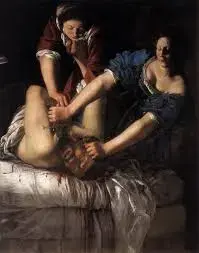
Works like Judith Slaying Holofernes are not allegories of vengeance. They are studies in resolve. Judith is not hysterical or ornamental—she is focused, controlled, and unwavering. Violence is not romanticized. It is executed.
This distinction matters.
Power Reimagined
Artemisia repeatedly returned to subjects of female strength—Judith, Susanna, Cleopatra, Lucretia—not as moral lessons, but as fully realized human moments. Her women act. They decide. They endure.
Unlike many of her contemporaries, Artemisia’s figures do not perform emotion for the viewer. They possess it.
Her Baroque is quieter than Caravaggio’s, but no less intense.
A Career, Not a Footnote
Artemisia worked across Italy—Florence, Rome, Naples—and became the first woman admitted to the Accademia delle Arti del Disegno in Florence. She received international commissions and maintained a professional studio at a time when women painters were rarely acknowledged as such.
Her legacy was long obscured, often reduced to biography rather than achievement. Today, that imbalance is finally being corrected.
She is not important because she was a woman who painted.She is important because she was a great Baroque painter.
Selected Works to Know
Judith Slaying Holofernes
Susanna and the Elders
Self-Portrait as the Allegory of Painting
Judith and Her Maidservant
Cleopatra
Each reveals Artemisia’s insistence on agency, gravity, and restraint.
A Final Thought
Artemisia Gentileschi does not soften the Baroque. She sharpens it.
Her paintings remind us that strength in art does not come from volume or exaggeration, but from conviction. The Baroque did not only belong to those who shouted the loudest—it belonged to those who endured and spoke clearly.
From the Studio
As painters, we often talk about honesty without considering its cost. Artemisia’s work reminds us that clarity is not decorative—it is earned. Painting becomes meaningful when it carries the weight of lived experience without apology.
Collectors Circle
The Collectors Circle is a private space for those who wish to follow the work more closely—new paintings, studio reflections, and early access to available pieces. It is not a mailing list in the usual sense, but a quiet correspondence reserved for a small group.
Reserved for the Few.


Comments