Caravaggio: The Man Who Dragged the Sacred Into the Light (Caravaggio Baroque painting)

There is Baroque painting before Caravaggio—and then there is everything that follows.
When Michelangelo Merisi da Caravaggio arrived in Rome at the end of the sixteenth century, religious painting was polished, idealized, and distant. Saints floated. Martyrs posed. Holiness was sanitized. Caravaggio shattered that distance. He pulled the sacred down into taverns, alleys, and dimly lit rooms. He painted saints with dirty feet, apostles with weathered hands, and divine moments unfolding in ordinary space.
Baroque painting, as we understand it today, begins with that rupture.
A World Ready for Shock
Caravaggio’s baroque paintings emergence coincided with the Counter-Reformation, when the Catholic Church demanded art that communicated directly, emotionally, and unmistakably to the faithful. Complexity gave way to clarity. Symbolism gave way to immediacy.
Caravaggio answered that demand—but on his own terms.
Rather than idealized bodies and heavenly light, he gave viewers:
Common people as sacred figures
Harsh, directional light slicing through darkness
Compositions staged like frozen moments in a drama
His paintings do not invite contemplation from a distance. They confront the viewer, pulling them into the scene as witnesses.
Light as a Weapon
Caravaggio did not invent chiaroscuro—but he weaponized it.
His use of tenebrism (deep shadow punctuated by violent light) is not decorative. Light becomes narrative. It isolates the essential action, strips away distraction, and forces the eye exactly where it must go.
In The Calling of Saint Matthew, the beam of light is not merely illumination—it is revelation. In The Incredulity of Saint Thomas, the light does not soften doubt; it exposes it.
This was not studio prettiness. It was psychological realism.
The Human Cost of Truth
Caravaggio’s commitment to realism was not theoretical. It was lived.
He used real models—laborers, prostitutes, boys from the street. He painted what he saw, not what tradition demanded. That honesty shocked patrons and unsettled clergy, but it also made his work unforgettable.
His personal life mirrored the intensity of his paintings:
Frequent brawls
Arrests
Exile
A fatal duel
Violence and fear haunt his later works. Heads are severed. Faces resemble his own. Darkness grows heavier. His final paintings feel burdened, remorseful, unresolved.
Caravaggio did not age into serenity. He burned out.
Why Caravaggio Still Matters
Caravaggio’s influence spread faster than any painter of his time. Entire schools formed in his wake—the Caravaggisti—across Italy, Spain, France, and the Netherlands. Artists like Ribera, Gentileschi, La Tour, and even Rembrandt absorbed his lessons, whether consciously or not.
More importantly, Caravaggio permanently changed what painting could be:
Truth over idealization
Emotion over ornament
Light as meaning, not decoration
For modern painters, his lesson is uncomfortable but essential:
If the painting does not risk something, it does not matter.
Selected Works to Know
The Calling of Saint Matthew
Judith Beheading Holofernes
The Incredulity of Saint Thomas
The Supper at Emmaus
David with the Head of Goliath
Each is a study in restraint, tension, and controlled brutality.

A Final Thought
Caravaggio did not paint beauty for beauty’s sake. He painted truth, and truth is rarely polite. The Baroque was not born from elegance—it was born from urgency.
Every Baroque painter that follows is responding to this moment, either by embracing it or pushing back against it.
That is why we begin here.
From the Studio
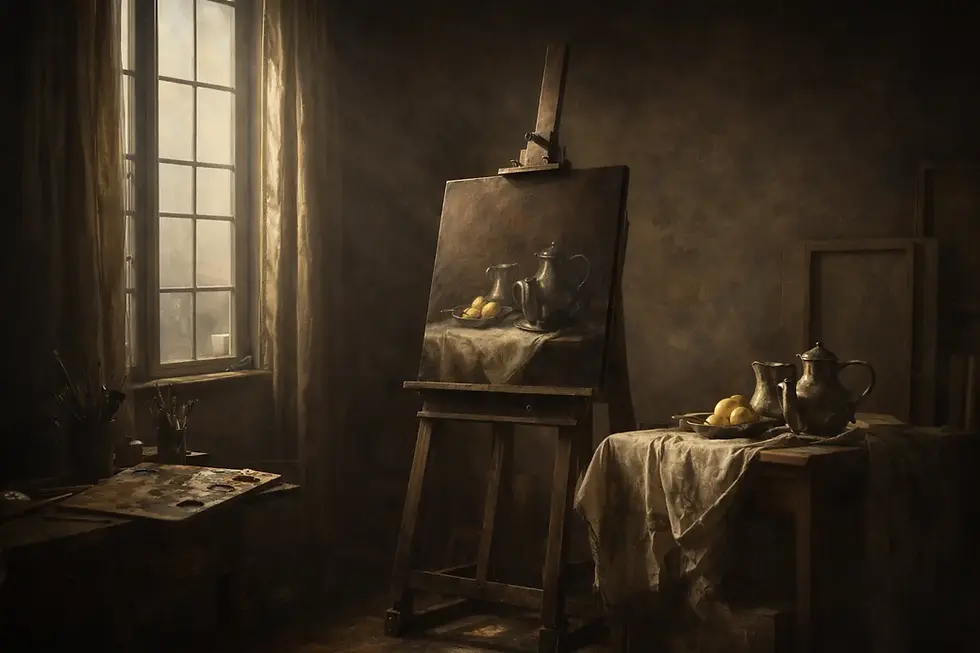
As painters today, we are often tempted to soften our work—to make it agreeable, decorative, safe. Caravaggio reminds us that painting’s real power lies in clarity, courage, and restraint. Light matters. Decisions matter. And honesty always leaves a mark.
For those who enjoy living with this kind of work, the Collectors Circle offers early viewing of new paintings, quiet studio notes, and occasional reflections shared directly from the studio.
You are welcome to learn more here.


Comments